Download Mendeley
Isoform-specific regulation of PKM by acetylation.
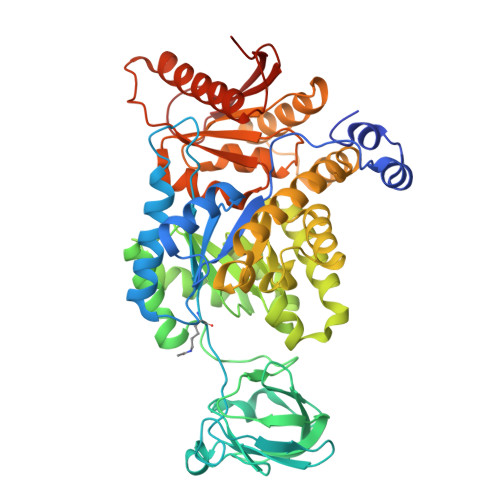
Pavlenko, D., Tamargo-Azpilicueta, J., Nudelman, H., Ankri, Y., Shahar, A., Diaz-Moreno, I., Arbely, E.(2025) Proc Natl Acad Sci U S A 122: e2527086122-e2527086122
- PubMed: 41289402
- DOI: https://doi.org/10.1073/pnas.2527086122
- Primary Citation of Related Structures:
9HIA, 9HIB, 9HIC - PubMed Abstract:
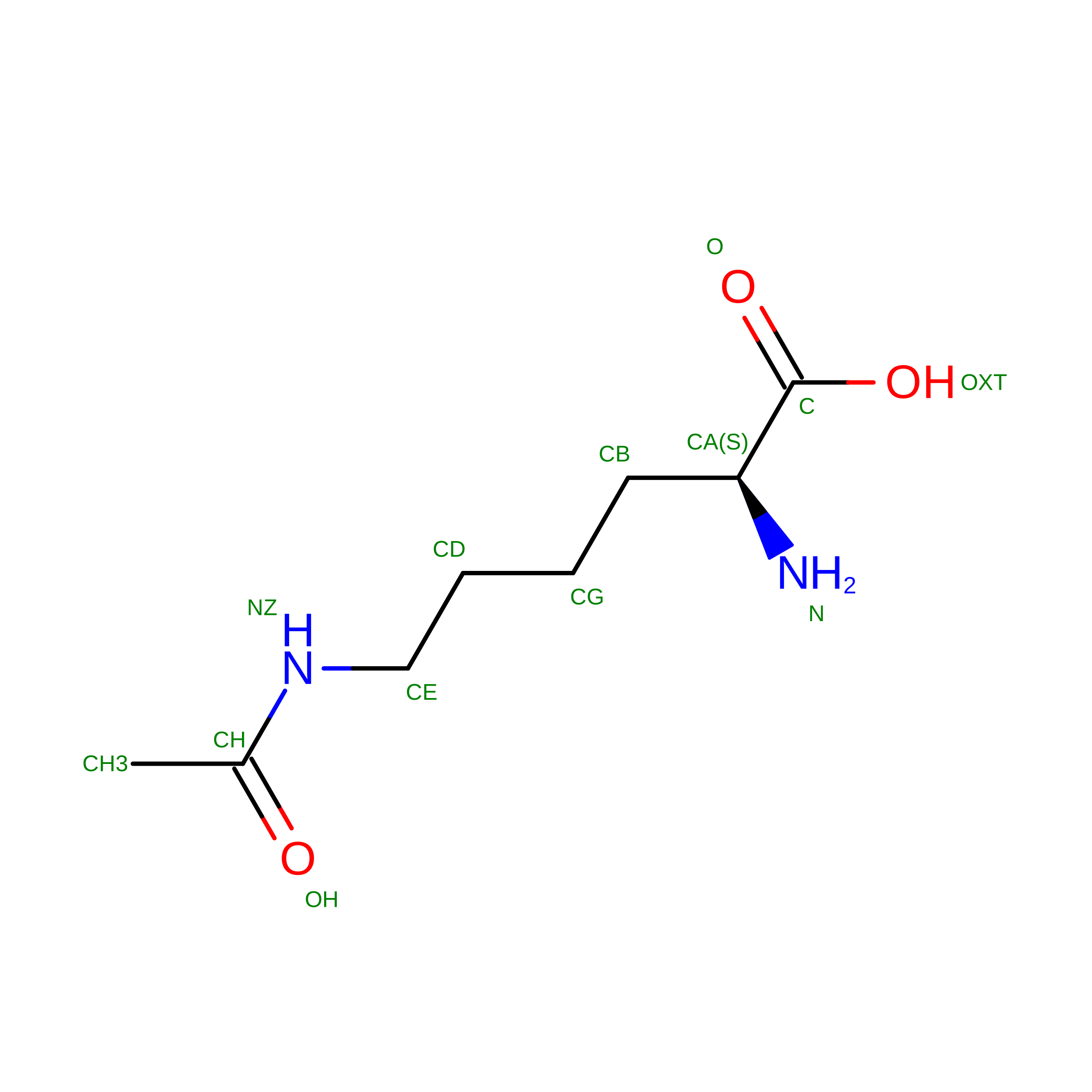
Pyruvate kinase (PK) is a crucial glycolytic protein involved in vital cellular processes ranging from cell proliferation to immune responses. The activity and functions of PK are tightly regulated by diverse mechanisms, including posttranslational Nϵ-lysine acetylation. Although previous studies have explored the impact of acetylation on selected lysine residues within the M2 isoform of PK (PKM2), a more comprehensive selection of acetylation sites and their respective effects on both PKM2 and the highly homologous PKM1 isoform is lacking. Here, we describe the structural, functional, and regulatory effects of site-specific acetylation on an expanded set of conserved lysines in PKM2 and selected lysines in PKM1. To study homogeneously acetylated proteins, we genetically encoded the incorporation of acetylated lysine into PKM variants expressed in bacteria and cultured mammalian cells. Our integrated biochemical, structural, and computational approach revealed K115 acetylation as an inhibitory modification in both PKM1 and PKM2 that stabilizes a closed active site conformation of the proteins. We also show that, in contrast to K115 acetylation, previously reported acetylation of K305 inhibits PKM2 but has no effect on the activity and oligomerization of PKM1. These findings propose the existence of both uniform and isoform-specific regulatory mechanisms of PKM, mediated by acetylation.
- Department of Chemistry, Ben-Gurion University of the Negev, Beer-Sheva 8410501, Israel.
Organizational Affiliation: