Download Mendeley
Antigenic landscape of Nipah virus attachment glycoprotein analysis reveals a protective immunodominant epitope across species.
Zhou, D., Wang, Y., Yao, Y., Kuang, W., Cheng, R., Zhang, G., Liu, H., Li, X., Chiu, S., Deng, Z., Zhao, H.(2025) NPJ Vaccines 11: 5-5
- PubMed: 41315143
- DOI: https://doi.org/10.1038/s41541-025-01319-2
- Primary Citation of Related Structures:
9LU3, 9LUE - PubMed Abstract:
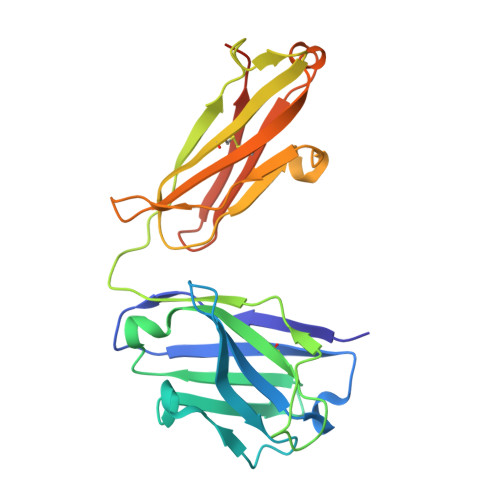
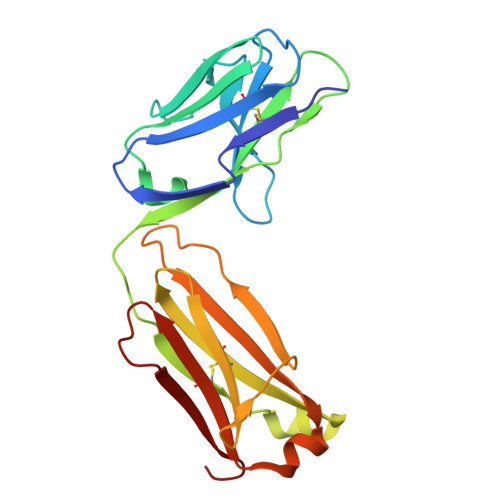
Nipah virus (NiV) and Hendra virus (HeV), two highly pathogenic Henipaviruses (HNVs), pose a significant public health threat. The attachment glycoprotein (G) plays a crucial role in viral attachment and entry, making it an attractive target for vaccine and therapeutic antibody development. However, the antigenic landscape and neutralization sensitivity of the diverse HNV G proteins remain poorly defined. Here, we systematically characterize 27 monoclonal antibodies (mAbs) elicited by NiV G head (G H ) nanoparticle-immunized mice. Among these, 25 mAbs exhibit neutralizing activity against two major NiV strains, NiV-Malaysia and NiV-Bangladesh, with five mAbs also cross-inhibiting HeV infection. Notably, mAbs from two distinct groups conferred complete protection to hamsters against lethal NiV-Malaysia challenge. Structural analysis of NiV G H in complex with representative Fabs reveals four non-overlapping epitopes, including two novel antigenic sites and one public protective epitope shared across species. MAbs targeting the novel sites bind to the top or side faces of G protein's β-propeller and inhibit viral infection by blocking either receptor engagement or membrane fusion. MAbs recognizing the public epitope block the receptor binding directly. Our study provides a comprehensive antigenic map of the NiV G H and offers new insights and opportunities for antibody-based therapies and rational vaccine development.
- State Key Laboratory of Virology and Biosafety, College of Life Sciences, Wuhan University, Wuhan, Hubei, China.
Organizational Affiliation: