Download Mendeley
Targeting bacterial kinases as a strategy to counteract antibiotic resistance.
Buffa, V., Kowalewski, J., Qi, G., Deutscher, R., Cica, M., Richardoz, M., Tomaszczyk, M., Kramer, A., Knapp, S., Dunyach-Remy, C., Rox, K., Guichou, J.F., Lionne, C., Hausch, F.(2025) Commun Chem 8: 390-390
- PubMed: 41345223
- DOI: https://doi.org/10.1038/s42004-025-01794-7
- Primary Citation of Related Structures:
9QOR, 9QOT, 9QOU, 9QOW, 9QOX, 9QOZ, 9QP0, 9QP1, 9QP2, 9QP3, 9QP5, 9QP6, 9QP7, 9QPA, 9QQJ, 9RL1 - PubMed Abstract:
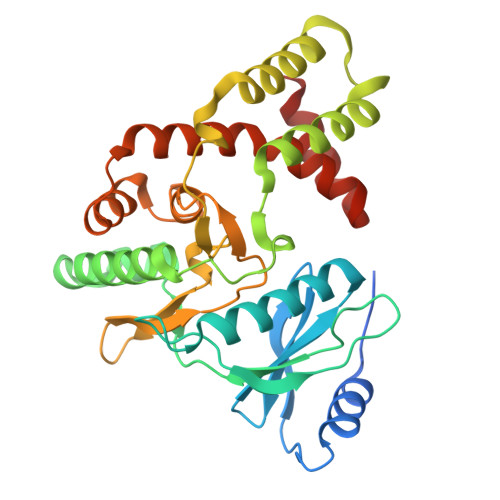
Antibiotic resistance is rapidly emerging as one of the most critical health threats, with resistant microorganisms progressively diminishing the effectiveness of established antibiotics. As a result, the development of therapeutic approaches that effectively target resistant pathogens is of utmost importance. In this study, we developed inhibitors for APH(2")-IVa, a bacterial kinase conveying resistance to aminoglycoside antibiotics. Starting from a hit of a fragment-based screening, we explored the inhibitory motif by structure-based design, ultimately leading to a series of triazole analogues. Advanced analogues displayed promising ADME properties, emerging selectivity vs a panel of human kinases, permeability in both Gram-positive and Gram-negative bacteria, and a moderate antibiotic efficacy for clinical strains of P. aeruginosa. Taken together, our results suggest inhibition of bacterial kinases could be a promising option to reinstall the efficacy of aminoglycoside antibiotics.
- Department of Chemistry, Institute of Organic Chemistry and Biochemistry, Technical University Darmstadt, Peter-Grünberg-Straße 4, Darmstadt, Germany.
Organizational Affiliation: