9SD6 | pdb_00009sd6

Crystal structure of the C-terminally truncated human E430Q/E574Q-PGGHG double mutant in complex with kojibiose


Experimental Data Snapshot

  • Method: X-RAY DIFFRACTION
  • Resolution: 1.70 Å
  • R-Value Free: 
    0.211 (Depositor), 0.217 (DCC) 
  • R-Value Work: 
    0.193 (Depositor), 0.202 (DCC) 

Starting Model: experimental
View more details

wwPDB Validation   3D Report Full Report


This is version 1.0 of the entry. See complete history


Literature

The structure of human glucosidase PGGHG reveals a very specific active site accessible through a flat surface for collagen approximation.

Casas-Florez, D.Ortega-Garcia, R.Sanz-Benito, P.Monterroso, B.Sanz-Aparicio, J.Gonzalez, B.

(2026) Int J Biol Macromol 345: 150556-150556

  • DOI: https://doi.org/10.1016/j.ijbiomac.2026.150556
  • Primary Citation of Related Structures:  
    9SD4, 9SD5, 9SD6, 9SD7, 9SD8

  • PubMed Abstract: 

    The enzyme glucosylgalactosylhydroxylysine glucosidase (PGGHG) plays a critical role in collagen metabolism by hydrolyzing the 2-O-α-d-glucopyranosyl-O-β-d-galactopyranose, a natural disaccharide found in the glycosylation of hydroxylysine residues in collagen. We report the X-ray crystallographic structure of human PGGHG, revealing the canonical four-domain fold of enzymes from the GH65 family and representing the first structure reported for a mammalian enzyme in this family. A distinctive flat surface adjacent to the catalytic site, shaped by the N-terminal β-sheet and specific conformations of catalytic loops, is unique to PGGHG among GH65 enzymes. Structural complexes with glucose and the substrate analogue kojibiose (KJB), along with site-directed mutagenesis and enzyme assays, identify residues critical for catalysis and hydroxylysine-collagen binding. Docking studies and AlphaFold3-based predictions suggest that the flat surface facilitates the contact between PGGHG and collagen peptides as well as substrate recognition, and support the enzyme's high specificity toward its glucosaccharide substrate. These findings provide structural insight into the selective recognition of glycosylated hydroxylysines and may inform future therapeutic or biotechnological applications targeting collagen metabolism.


  • Organizational Affiliation
    • Department of Crystallography and Structural Biology, Institute of Physical-Chemistry Blas Cabrera, CSIC, Serrano 119, 28006, Madrid, Spain.

Macromolecules
Find similar proteins by:  (by identity cutoff)  |  3D Structure
Entity ID: 1
MoleculeChains Sequence LengthOrganismDetailsImage
Protein-glucosylgalactosylhydroxylysine glucosidase693Homo sapiensMutation(s): 2 
Gene Names: PGGHGATHL1
EC: 3.2.1.107
UniProt & NIH Common Fund Data Resources
Find proteins for Q32M88 (Homo sapiens)
Explore Q32M88 
Go to UniProtKB:  Q32M88
PHAROS:  Q32M88
GTEx:  ENSG00000142102 
Entity Groups  
Sequence Clusters30% Identity50% Identity70% Identity90% Identity95% Identity100% Identity
UniProt GroupQ32M88
Sequence Annotations
Expand
  • Reference Sequence
Oligosaccharides

Help

Entity ID: 2
MoleculeChains Length2D Diagram Glycosylation3D Interactions
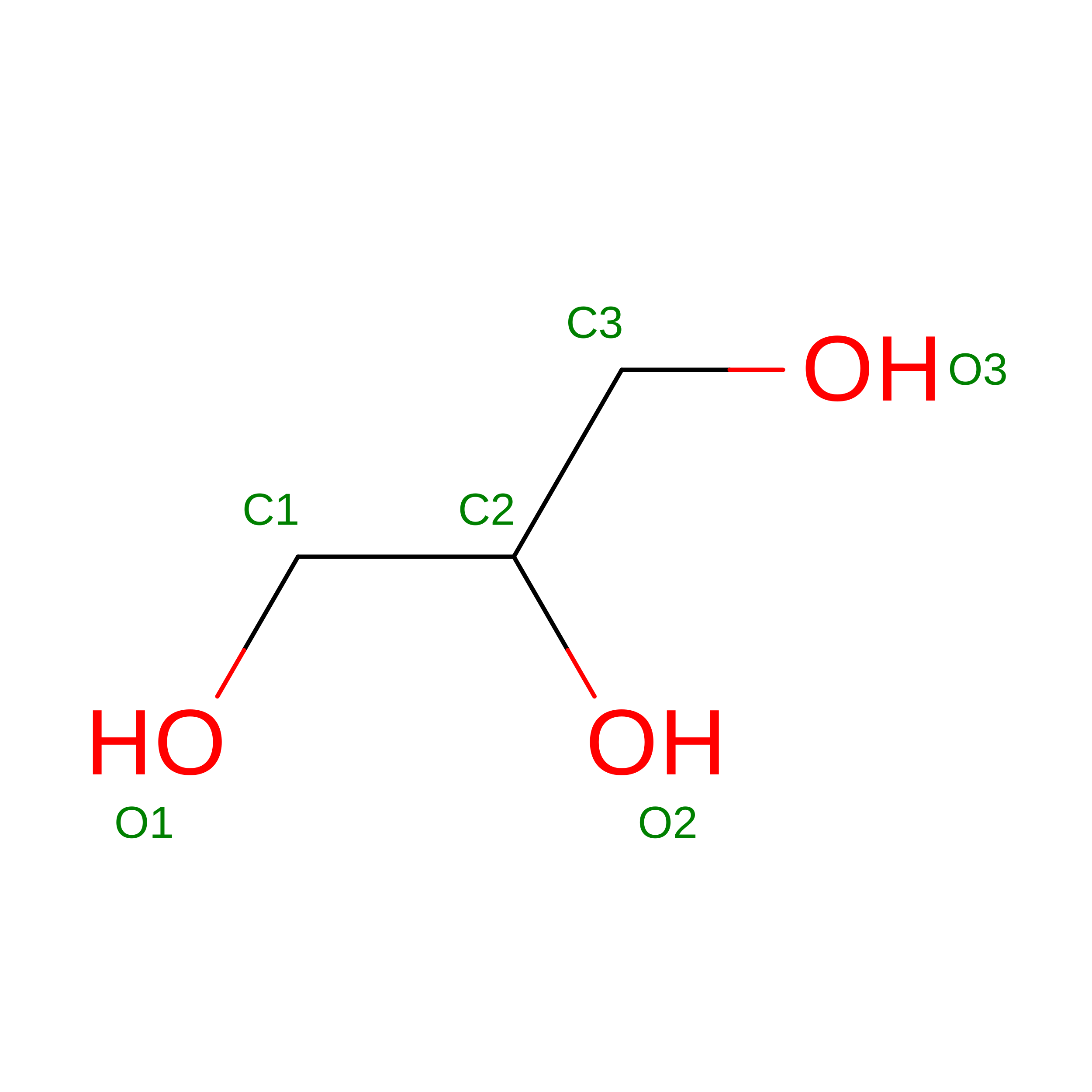
alpha-D-glucopyranose-(1-2)-alpha-D-glucopyranose
B
2N/A
Entity ID: 3
MoleculeChains Length2D Diagram Glycosylation3D Interactions
alpha-D-glucopyranose-(1-2)-beta-D-glucopyranose
C
2N/A
Experimental Data & Validation

Experimental Data

  • Method: X-RAY DIFFRACTION
  • Resolution: 1.70 Å
  • R-Value Free:  0.211 (Depositor), 0.217 (DCC) 
  • R-Value Work:  0.193 (Depositor), 0.202 (DCC) 
Space Group: P 1 21 1
Unit Cell:
Length ( Å )Angle ( ˚ )
a = 54.005α = 90
b = 77.169β = 99.249
c = 79.055γ = 90
Software Package:
Software NamePurpose
REFMACrefinement
autoPROCdata processing
MOLREPphasing
Cootmodel building
autoPROCdata reduction
Aimlessdata scaling

Structure Validation

View Full Validation Report


Entry History & Funding Information

Deposition Data


Funding OrganizationLocationGrant Number
Ministerio de Ciencia e Innovacion (MCIN)SpainPID2020-117400GB-I00
Ministerio de Ciencia e Innovacion (MCIN)SpainPID2023-147659NB-I00

Revision History  (Full details and data files)

  • Version 1.0: 2026-02-11
    Type: Initial release