Download Mendeley
Independent horizontal transfer of genes encoding alpha / beta-hydrolases with strigolactone binding and hydrolytic activities from bacteria to fungi and plants.
Wang, Q., Ye, Y., Wang, L., Guan, Y., Wang, S., Wang, Z., Sun, H., Smith, S.M., Huang, J.(2025) Mol Plant 18: 1949-1961
- PubMed: 41039777
- DOI: https://doi.org/10.1016/j.molp.2025.09.021
- Primary Citation of Related Structures:
9WLV - PubMed Abstract:
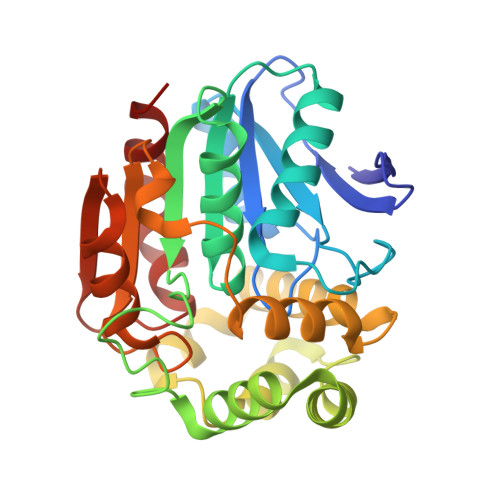
Strigolactones (SLs) are not only phytohormones that influence multiple aspects of plant growth and development but also signaling molecules for interactions between plants and certain fungi or bacteria. In plants, the SL receptor is an α/β-hydrolase (ABH) encoded by the DWARF14 (D14)/KARRIKIN INSENSITIVE2 (KAI2) gene family, which is known to be derived from proteobacterial RsbQ through horizontal gene transfer (HGT). In the phytopathogenic fungus Cryphonectria parasitica, another ABH named CpD14 was found to possess SL binding and hydrolytic activities and mediate SL responses, exhibiting potential SL perception functions. Here, we demonstrate that CpD14 and its homologs in Leotiomyceta fungi were derived from Actinobacteria through an independent HGT event, forming a distinct CpD14-like (CDL) family across fungi and bacteria. X-ray crystallography and structural analyses reveal that actinobacterial and fungal CDL proteins share a conserved core "α/β fold" domain with D14/KAI2/RsbQ but possess a unique lid domain. Biochemical assays show that both actinobacterial CDL and proteobacterial RsbQ can recognize and hydrolyze SLs, suggesting that they are pre-adapted for SL responses and potential perception. Both plant D14/KAI2 and fungal CDL proteins retained these functional activities, whereas they evolved distinct ligand specificities for SL structural variants. Collectively, this work reveals that independent HGT events from two bacterial groups provided plants and their interacting fungi with pre-adapted ABH proteins, which were deployed for SL perception or responses.
- State Key Laboratory of Plant Diversity and Specialty Crops & Yunnan Key Laboratory for Fungal Diversity and Green Development, Kunming Institute of Botany, Chinese Academy of Sciences, Kunming 650201, China.
Organizational Affiliation: