Download Mendeley
gamma delta T cell receptor recognition of CD1d in a lipid-independent manner.
Rice, M.T., Gunasinghe, S.D., Sok, C.L., Pan, M., Lay, C.S., Gully, B.S., Rossjohn, J.(2025) Nat Commun 17: 926-926
- PubMed: 41457154
- DOI: https://doi.org/10.1038/s41467-025-67653-0
- Primary Citation of Related Structures:
9O4X - PubMed Abstract:
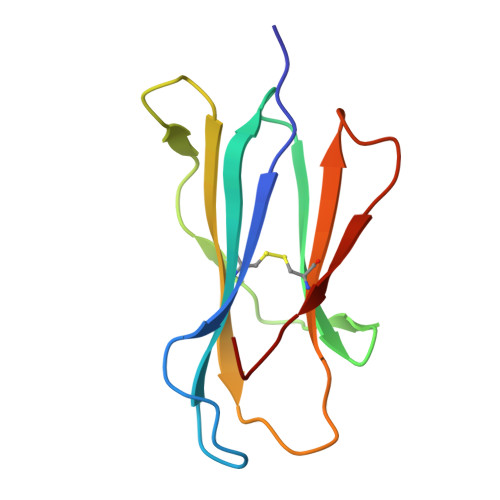
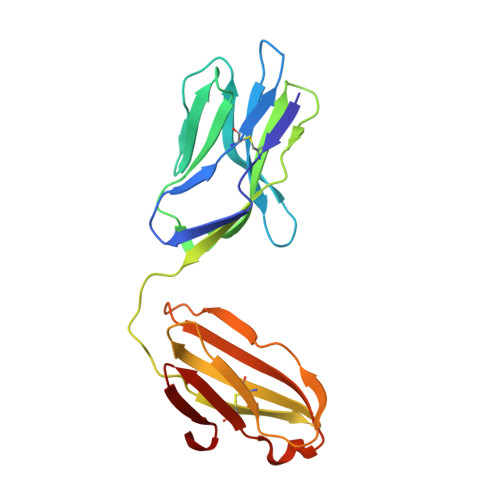
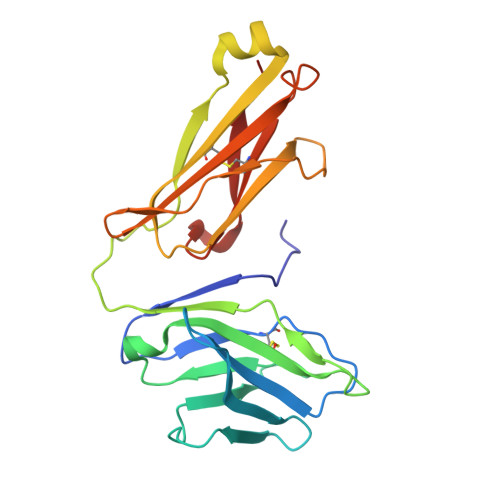
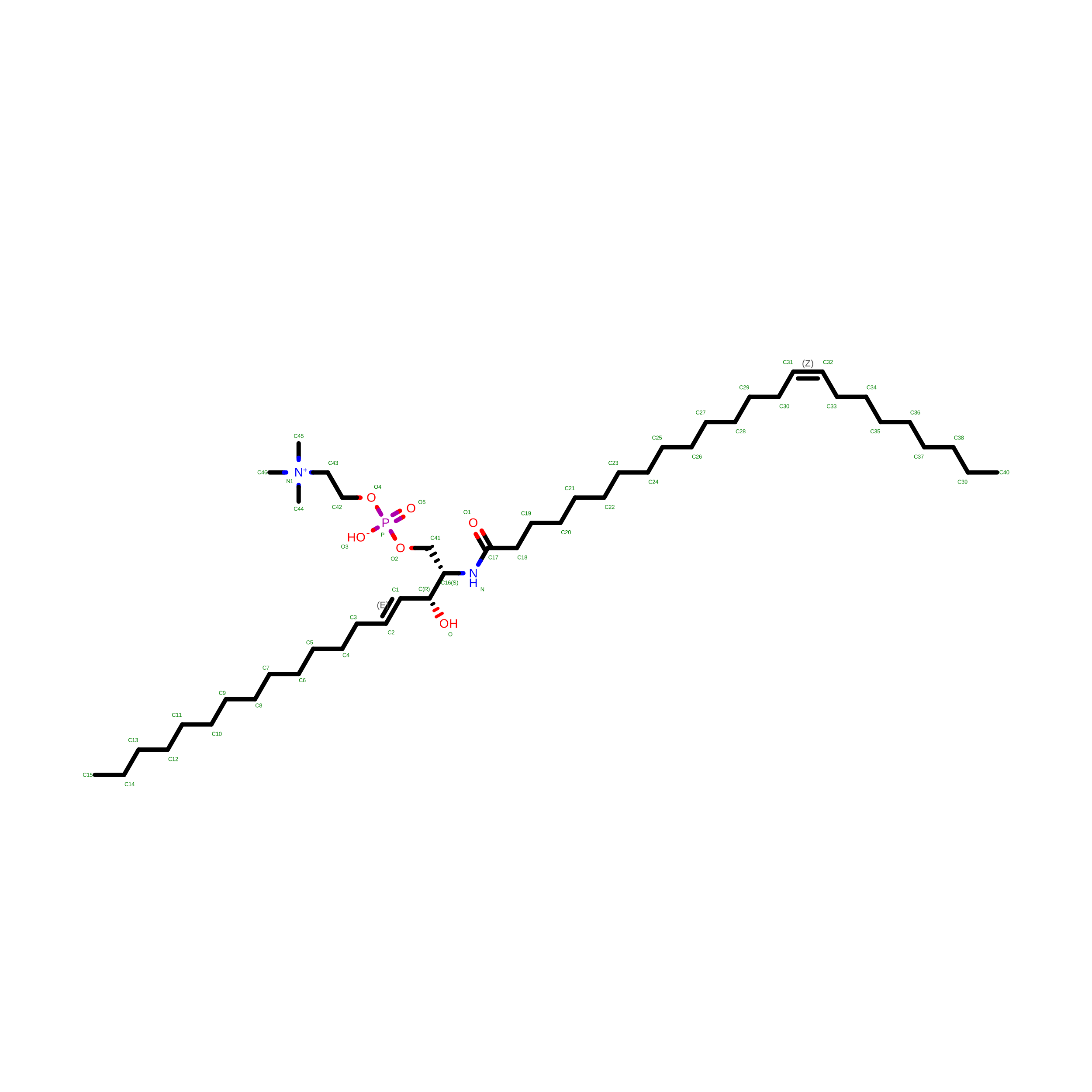
The monomorphic antigen-presenting molecule CD1d presents lipid antigens to both αβ and γδ T cells. While type I natural killer T cells (NKT) display exquisite specificity for CD1d presenting α-galactosylceramide (α-GalCer), the extent of lipid specificity exhibited by CD1d-restricted γδ T cells remains unclear. Here, we demonstrate that human γδ T cell receptors (TCRs) can recognise CD1d in either a lipid-dependent or lipid-independent manner with weak to moderate affinity. Using small-angle X-Ray scattering, we find that γδ TCR-CD1d binding modality is conserved across distinct CD1d-restricted TCRs. In functional assays, CD1d γδ TCR affinity was a poor predictor of γδ T cell line activation. Moreover, CD1d presenting endogenous lipids was sufficient to stimulate T cell activation and induce γδ TCR-CD3 clustering and phosphorylation in a dose-dependent manner. Elongation of the γδ TCR-CD3 complex by the inclusion of the Cγ2 and Cγ3 -encoded constant domains perturbed cellular activation whilst maintaining the ability to form functional γδ TCR clusters. The crystal structure of a Vδ1 γδ + TCR-CD1d complex showed that the γδ TCR sat atop of the CD1d antigen-binding cleft but made no contacts with the presented lipid antigen. These findings provide a molecular basis for lipid-independent CD1d recognition by γδ TCRs.
- Infection and Immunity Program and Department of Biochemistry and Molecular Biology, Biomedicine Discovery Institute, Monash University, Clayton, Victoria, Australia.
Organizational Affiliation: