Download Mendeley
Examination of Noncanonical Kinase Hinge Binders Leads to Thiadiazoles as Potent IRAK4 Inhibitors.
Ammann, S.E., Brizgys, G., Ferrao, R.D., Wright, N.E., Mukherjee, P.K., Bacon, E.M., Chin, E., Chou, C., Cottell, J.J., Hammond, A., Ndukwe, M.S., Park, G.Y., Shatskikh, M.E., Suekawa-Pirrone, K., Warr, M.R., Yang, Z.Y., Zipfel, S.M., Taylor, J.G.(2026) ACS Med Chem Lett 17: 175-182
- PubMed: 41531974
- DOI: https://doi.org/10.1021/acsmedchemlett.5c00602
- Primary Citation of Related Structures:
9PSS, 9PST, 9PSU - PubMed Abstract:
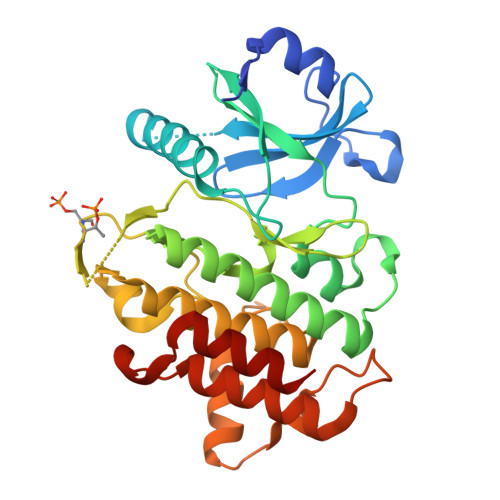
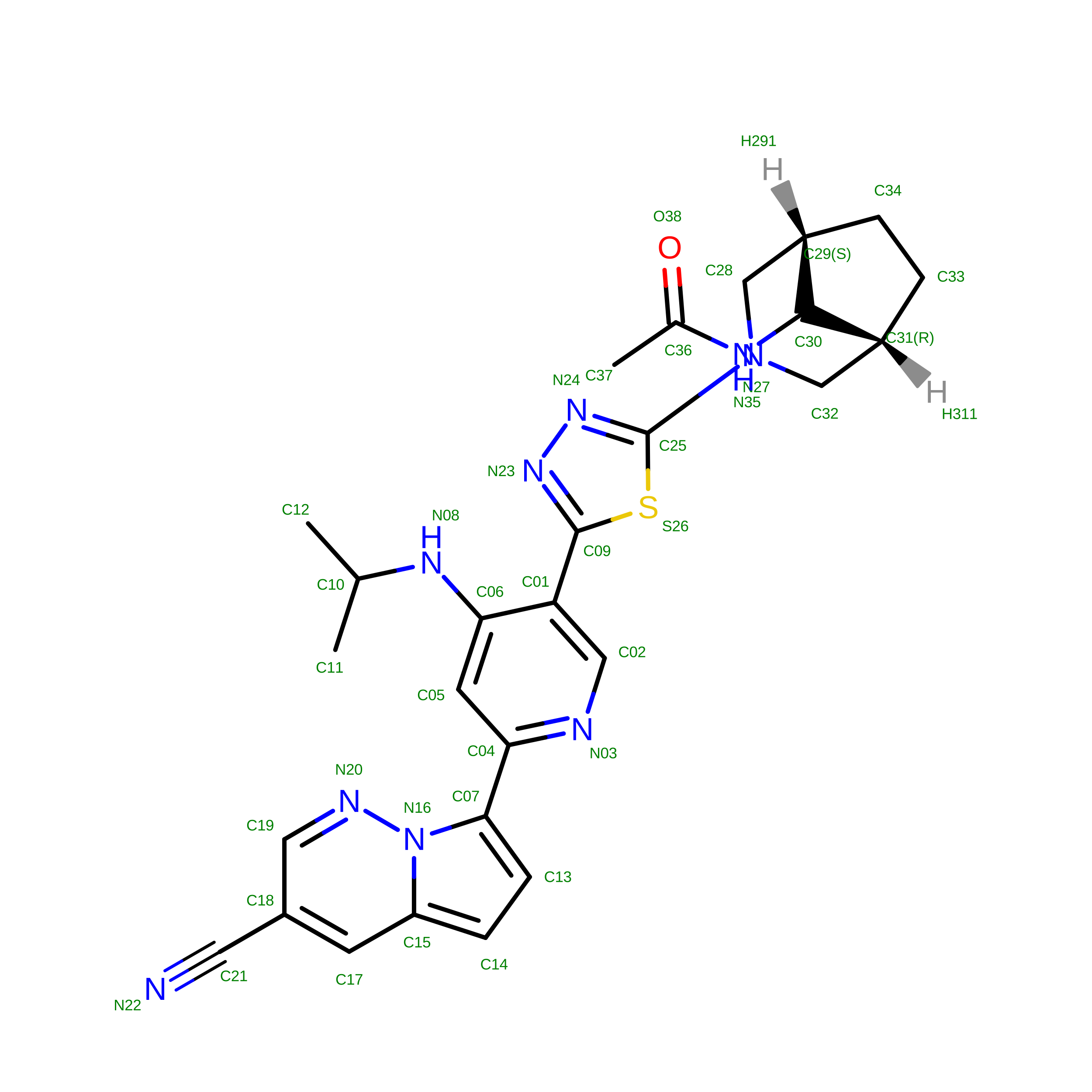
A hallmark of most known small-molecule orthosteric kinase inhibitors is hydrogen-bonding to the hinge-region of the kinase to mimic the hinge interaction of adenine. Herein we report our studies on deviation from canonical hinge-binders in the context of IRAK4 inhibitors. Small-molecule inhibitors of IRAK4 have generated interest as potential treatments for inflammatory diseases. Notably, in our discovery efforts we identified pyridinyl-thiadiazoles as noncanonical hinge-binders. X-ray structural evidence supports that the thiadiazole moiety engages in a rare intermolecular noncovalent sulfur-oxygen interaction. This thiadiazole series, exemplified by compounds 19 and 22 , has shown promise for potent, selective, orally bioavailable IRAK4 inhibitors.
- Gilead Sciences Inc., 333 Lakeside Drive, Foster City, California 94404, United States.
Organizational Affiliation: